Fitness Boxing: Drills for Conditioning
November 21, 2026
Fitness boxing is boxing training done for conditioning: the same stance, footwork, punches and rounds a boxer uses, with getting in shape as the goal and no fight at the end of it. If you are a woman who feels out of shape and assumes a boxing gym is not built for her, or a man who has quietly decided it is too late to start, this is the format that answers that fear. The drills are real. The goal is yours.
Key takeaways
- Fitness boxing is boxing drills for conditioning — no sparring, no bout to prepare for.
- A regular boxing group trains boxing as a sport, with the longer path toward competitive boxing.
- Both are built on rounds with short rests, which is why boxing is cardio.
- Fitness boxing is one of KRASAVA’s services.
- Kids and teens train in their own groups — kids boxing starts from age 6.
- Your first group class is free — call or text (732) 339-2894.
Fitness boxing explained: boxing drills done for conditioning
Fitness boxing is a boxer’s training — stance, footwork, punches, shadowboxing, bag and pad rounds — done to get in shape rather than to prepare for a bout. There is no sparring and no competition in it. You learn to stand, move and throw a clean punch, and the rounds do the rest: the heart rate climbs, the legs and core work, and the session ends with you tired in the way a boxer gets tired, without anyone having hit you.
Fitness boxing lives inside a boxing gym and not a generic fitness studio because the work is real boxing work. The jab is a jab, the bag round is a bag round, the footwork is footwork; only the purpose changes. A gym that trains boxers has the bags, the timer and the coaching eye for technique that boxing for exercise depends on. At KRASAVA Boxing Academy, fitness boxing is one of our programs, serving Philadelphia and Northeast Philadelphia; the gym’s address is in Huntingdon Valley.
How fitness boxing differs from a regular boxing group
Fitness boxing and a regular boxing group differ by purpose, not by quality: one uses the round to build your conditioning, the other uses the round to build a boxer. In fitness boxing, the drills are chosen and sequenced for heart rate, work capacity and movement. Technique is kept clean so the wrist stays straight on the bag and the shoulder is not grinding on every punch, but nobody is being built toward a fight. The boxer training workout you get is honest boxing training without the layers a fighter needs.
A regular adult boxing group, in general boxing terms, trains boxing as a sport: the same drills, and then the layers a fighter needs — defensive reactions, timing, reading a partner, partner work that progresses toward controlled sparring. Competitive boxing is the far end of that road, and it is one of the academy’s services for those who want the boxing ring rather than only the bag. Boxing lessons on that path still start with the same jab, the same stance, the same footwork — the difference is what each round is for and where the rounds are heading.
Here is how the two formats compare as formats, by what they are for:
| Fitness boxing | Regular boxing group | |
|---|---|---|
| Goal | Conditioning, coordination, a real skill | Boxing as a sport, toward competitive boxing for those who want it |
| What a round looks like | Shadowboxing, bag and pad rounds, circuit blocks between them | The same drills plus defense, timing and partner reaction work |
| Sparring | None | Progressive and optional |
| Who usually picks it | Adults who want to get fit and learn to punch properly | Adults who want to box as a sport and maybe compete |
Fitness boxing, adult boxing and competitive boxing are all our services, and all of them are real boxing. Choose by what you want the round to do for you.
Why boxing is cardio: the round timer and the shape of a workout
Boxing is cardio because it is built on the round: a timed work interval, a short rest, then the next interval before you have fully recovered. Punching combinations spike the heart rate fast — the legs drive, the trunk rotates, the arms deliver — and the rest lets it fall only partway. When the bell goes again, you start the next round already breathing hard.
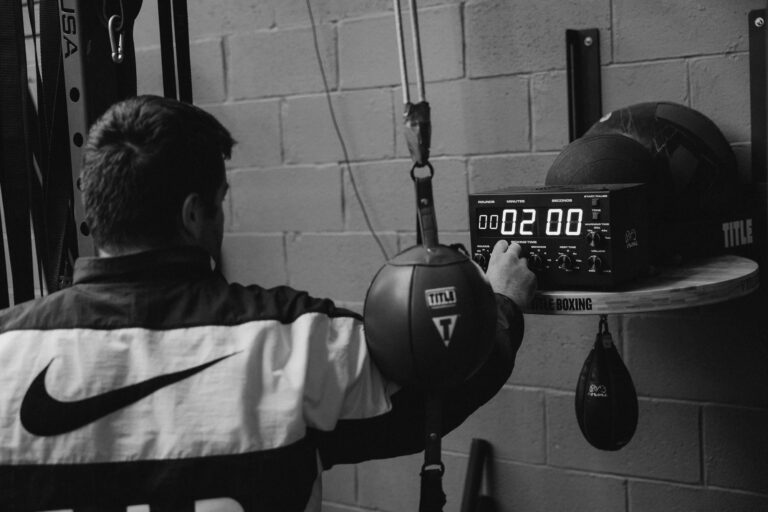
Two minutes on the round timer, set by our coach before a boxing class: that is the setting in the frame, and two minutes is a common training round length in boxing generally. The rest between rounds in boxing practice is typically around a minute or less, so the heart rate never fully settles before the next bell. Repeated across a session, that pattern trains both aerobic capacity and the ability to produce effort again and again — which is exactly what a boxer’s cardio needs and what an aerobic boxing workout delivers to someone who never plans to fight.
The timer is what keeps an aerobic boxing workout honest: you work until the bell, not until you feel like stopping, and you rest until the bell, not until you feel ready. That same device runs the sport groups in a boxing gym. The fighters and the people doing boxing for exercise answer to the same bell — which is why fitness boxing feels like boxing and not like a dance class with gloves.
What a boxing fitness workout includes
A boxing fitness workout is built from six blocks: warm-up, shadowboxing, heavy bag rounds, pad or partner drills, bodyweight circuit training between rounds, and a cool-down. This is the general shape of fitness boxing in a boxing gym, not a fixed script — a coach moves the blocks around depending on the day and the group. Beginner boxing drills need no prior experience; the conditioning comes from the boxing movements themselves, and you pick those up as you go.
- Warm-up — jump rope and mobility work: raises the heart rate, opens the hips, shoulders and ankles, and wakes up the calves for the footwork to come.
- Shadowboxing — rounds of stance, footwork and combinations with no target: builds coordination and rhythm, loads the legs and the rotating core.
- Heavy bag rounds — power and endurance against resistance: the whole chain from feet to fist works, and the lungs work hardest here.
- Pad or partner drills — accuracy and reaction: the target moves, so you have to think and adjust, not just swing.
- Circuit training between rounds — squats, push-ups, core work: keeps the heart rate up and loads the muscles that boxing alone under-uses.
- Cool-down — easy movement and stretching to bring the heart rate down and keep the shoulders loose for the next session.
Every one of these boxing exercises serves conditioning in a different way: the bag builds endurance, the pads build reaction, the circuit builds strength endurance, and shadowboxing ties the footwork to the punches. Circuit training is also one of the programs at KRASAVA in its own right, for people who want the conditioning blocks of a boxing class workout as a focus.
Partner drills: a straight punch with a high guard
Partner drills in fitness boxing are cooperative, not sparring: one person works, the other holds a target or mirrors the movement, and the straight punch is the first thing both of them learn to do correctly. A straight punch starts from the legs, turns through the hips and shoulder, extends with the wrist straight behind the knuckles, and lands while the other hand stays high beside the chin. That is boxing training whether you ever plan to box or not.
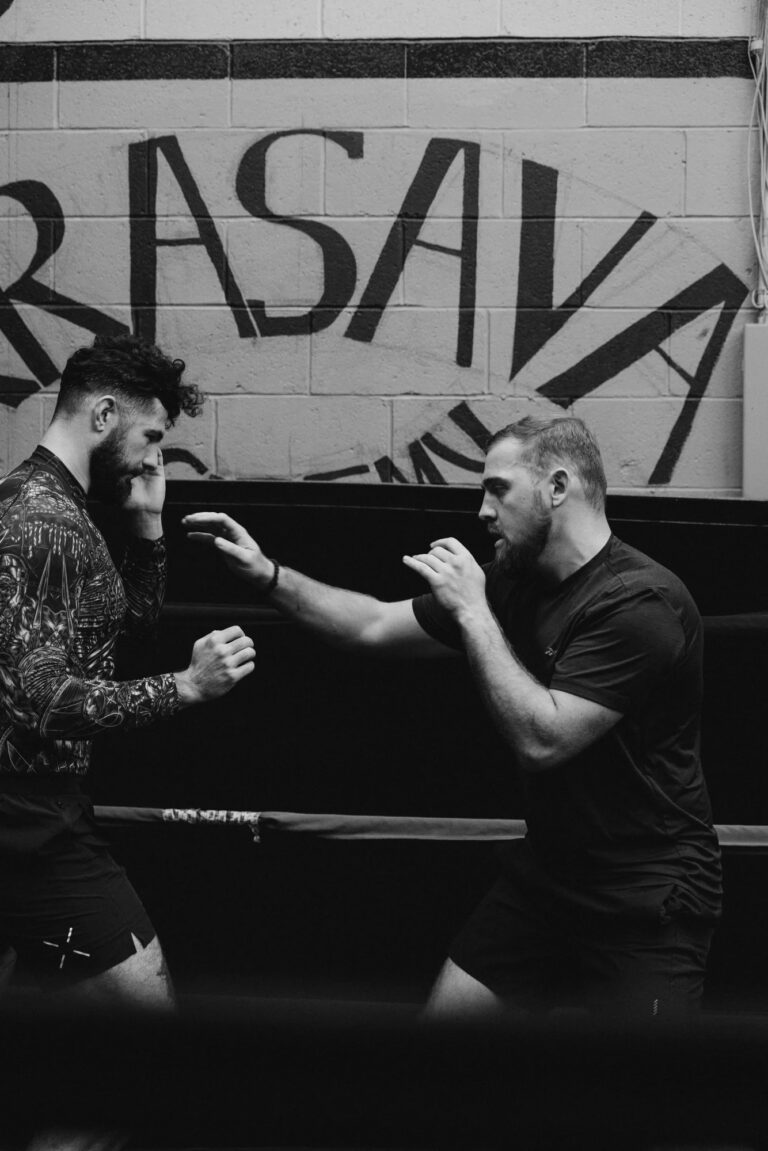
Two adults working a straight punch from a high guard, the KRASAVA mural on the wall behind them — that is one of our adult partner drills. In a conditioning class the technique matters for a practical reason: a sloppy punch on a bag or pad bends the wrist and yanks the shoulder, and a bent wrist on impact can leave the joint sore for days. A clean punch lets you keep hitting round after round, which is where the cardio lives.
The high guard is not decoration either. Keeping the free hand up through every repetition builds shoulder endurance, and a newcomer tends to notice that quickly. For someone who wants that mechanic worked one-on-one before joining the group, personal boxing training is the option.
Benefits of boxing as an exercise
The benefits of boxing as an exercise come from the mechanics of the work: it is a full-body load, an interval cardio session, a coordination drill and a mental reset at the same time. Every punch is a chain — the legs drive, the core rotates, the shoulders and back deliver — so a round on the bag is not an arm workout; it is the whole body repeating a coordinated effort under fatigue. The round structure turns that into interval cardio, and the combinations and partner drills add reaction and coordination that a treadmill never asks of you.
The mental side is real and underrated. Hitting a heavy bag after a long work day lands differently than a spin class, and a four-punch combination forces you to think about the combination instead of the day. For a woman who has not trained in years, or a man who feels he started too late, that focus is the part of boxing for exercise that does not feel like exercise — it feels like learning something.
One honest limit: boxing conditioning builds endurance, tone and work capacity, not large muscle mass. If your only goal is to get strong, boxing for exercise is a good complement, but you will still want barbell work.
Who fitness boxing fits — and who should pick another group
Fitness boxing fits adults who want conditioning and a real skill without a fight at the end of it. That includes people coming back from years without exercise, women who want to train in a boxing gym — women’s boxing is one of KRASAVA’s programs — and men who think they started too late. Whether you are starting boxing at 20, at 40 or later, there is no age at which a stance and a straight punch stop being learnable, and no prior experience is needed for the drills. Beginner boxing questions about gloves, stance and nerves have their own article, “Beginner boxing”, but none of them are a reason to wait.
If what you want is to learn boxing as a sport, eventually spar and perhaps try competitive boxing, that is one of the academy’s services too. Nothing about that choice is better or worse than fitness boxing; it is a different destination for the same rounds. And if you are a parent reading this for a child: youth boxing at KRASAVA runs in its own groups — kids boxing from age 6, and teen boxing — not in the adult groups. The children’s groups are their own program, covered in the article on kids boxing.
| Fitness boxing | Boxing as a sport | Kids & teens groups | |
|---|---|---|---|
| Goal | Conditioning and skill | Boxing as a sport, toward competitive boxing for those who want it | Youth boxing in age-matched groups |
| Who it fits | Adults who want to get fit without a fight | Adults who want to spar and maybe compete | Kids boxing from age 6 and teen boxing, separate from adults |
One caveat that applies to any high-intensity exercise: anyone with a heart condition, a recent injury or a pregnancy should clear it with their doctor before the first round, not after.
Fitness boxing at KRASAVA in Philadelphia: how to start
Fitness boxing is one of the programs at KRASAVA Boxing Academy. The gym serves Philadelphia and Northeast Philadelphia along with nearby Huntingdon Valley, Bryn Athyn, Southampton and Bensalem; the address is in Huntingdon Valley.
What to bring is simple in boxing terms: comfortable clothes you can move in and a bottle of water. Gloves and hand wraps are the equipment of the sport — ask when you call before you buy anything. Membership price depends on which group you join and how often you train; the figures live in our article “Cheap boxing gym”, which covers prices in full.
The first step costs nothing. Your first group class is free — call or text (732) 339-2894 and come try a round.
FAQ
- What are the benefits of boxing?
Boxing as an exercise loads the whole body — legs drive, core rotates, shoulders and back deliver — and the round structure turns it into interval cardio. Combinations and partner drills build coordination and reaction, and focusing on a combination is a genuine mental reset. The honest limit: it builds endurance and tone, not bulk.
- What are some boxing workouts?
Common boxing fitness workouts are built from blocks: jump rope and mobility to warm up, shadowboxing rounds for footwork and combinations, heavy bag rounds for power and endurance, pad or partner drills for accuracy, and bodyweight circuit training — squats, push-ups, core work — between rounds. Coaches arrange the blocks differently day to day.
- Is boxing cardio?
Yes. A boxing workout runs on a round timer: a work interval of punching, a short rest, then the next round before full recovery. Repeated, that trains aerobic capacity and the ability to repeat hard efforts. Two minutes is a common training round length.
- I haven’t exercised in years — can I start with fitness boxing?
Yes. The fitness boxing drills need no prior experience; the conditioning comes from boxing movements you learn as you go, starting with stance and a straight punch. If you have a heart condition, recent injury or other health concern, clear high-intensity exercise with your doctor first. Then take the free first group class — call or text (732) 339-2894.