Beginner Boxing Classes: What to Expect Day One
November 21, 2026
Beginner boxing classes start with the coach showing and explaining every movement, so nobody is expected to walk in already knowing how to box. At KRASAVA Boxing Academy the first group class is free. You bring comfortable sportswear, clean shoes to change into, water and a towel; gloves are available at the gym. There are groups for kids from age 6, teens, adults and women, and the day and time of your group is given by phone or text at (732) 339-2894. Below is what a first class actually looks like, who comes to one, and what each of them is quietly worried about.
Key takeaways: the short version before your first visit
- The first group class is free.
- No experience is needed — the coach shows and explains everything, from the stance to the first punch.
- Bring comfortable sportswear, clean shoes to change into, water and a towel; gloves are available at the gym.
- Groups exist for kids from age 6, teens, adults and women — you join the one that matches who you are, not how fit you think you should be.
- To pick a group and get the day and time it trains, call or text (732) 339-2894.
Why beginner boxing classes feel scarier than they are
Beginner boxing classes feel intimidating because people arrive carrying one of three fears, and none of them is really about boxing. A parent worries that a child will get hurt. A woman worries she is too out of shape to walk through the door of a boxing gym without embarrassment. A man worries it is too late for him to start anything that involves a ring and gloves.
One fact answers all three: at a first class the coach shows and explains everything, and nobody is expected to already know how to box. That is the whole premise of beginner boxing — boxing classes for people who have never thrown a punch. For readers in Philadelphia and Northeast Philadelphia looking for boxing classes near me, our gym is located in Huntingdon Valley, and the rest of this article is about what happens once you arrive.
Who shows up to a first class — and what each of them is afraid of
Three kinds of first-timers show up to beginner boxing classes, and each walks in with a different worry.
Parents of kids from age 6 and teens
The fear in kids boxing and teen boxing is injury. In the craft, a beginner’s first weeks are stance, footwork, hand position and hitting pads or a heavy bag — not getting hit. Youth boxing at the beginner stage is taught movement by movement: the coach shows and explains a step or a punch, the child repeats it, and the next piece is added only when the previous one holds. Parents searching for boxing classes for youth near me usually picture sparring; what a child actually meets in the first weeks is closer to a coordination lesson with gloves on.
Women who feel out of shape
The fear is being the slowest person in the room. A beginner class is built around learning movements, and conditioning is a byproduct that arrives over weeks of showing up — it is not a ticket you need before the door. A women’s boxing gym group suits someone who prefers to learn those movements alongside other women; it is simply a different room for a different person, not an easier or harder version of the same boxing lessons adults get elsewhere in the gym.
Men who think it is too late
The fear is age. Starting boxing at 20, 30 or 40 is common in adult boxing groups because the first goals of boxing training for adults are technique and fitness, not a competitive debut.
| Who comes | What they worry about | What actually happens at a first class |
|---|---|---|
| Parents of kids from age 6 and teens | The child will get hurt | Stance, footwork, hand position, pads or bag — each movement shown and explained first |
| Women who feel out of shape | Being the slowest in the room | The coach shows and explains every movement; conditioning builds over weeks |
| Men who think it is too late | Age | Technique and fitness goals in an adult group — no competitive clock |
What actually happens at your first class
A beginner boxing class usually opens with a warm-up — jump rope, light movement, joint mobility for shoulders, hips and ankles — and then moves straight into the stance and the guard: where the feet go, where the hands sit, how the chin tucks. From there come the first two punches, the jab and the straight, followed by footwork drills so the stance survives movement. Only then does shadow boxing begin: throwing those punches in the air, often in a corner of the boxing ring or near the ropes so the beginner has a reference point for distance and direction. This is the sequence most boxing lessons follow because each piece depends on the one before it.
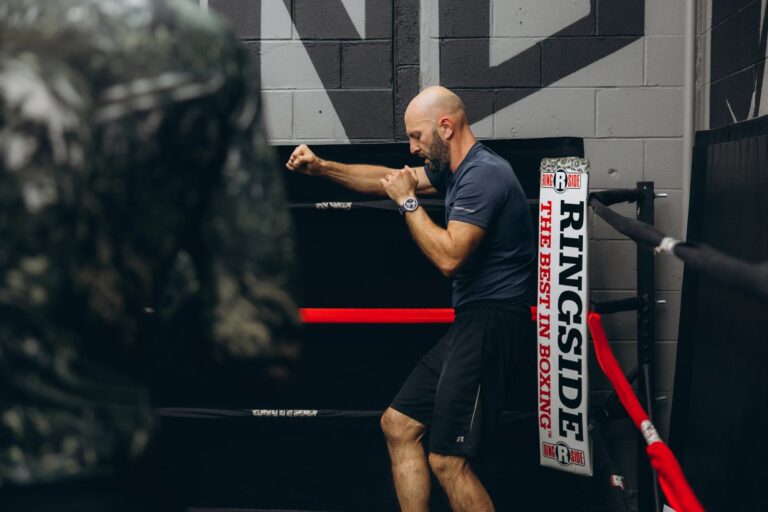
Two ropes meeting behind a boxer give a physical limit, so the boxer can feel when the feet drift and when the punches stop at the right distance. In a drill like this, the work is the shape of the punch — the elbow staying under the fist, the rear heel turning on the straight, the guard returning to the face — repeated until the body stops needing to think about it.
Shadow boxing comes before bag or pad work for a plain reason: impact is a distraction. When a glove lands on a bag, a beginner feels the hit and starts chasing the sound of it, and the technique collapses. In the air there is nothing to chase, so the coach can see the stance, the hand path and the return, and correct them while they are still cheap to fix. Once the shape is there, the bag and the pads simply confirm it. A first class in a gym with boxing classes for beginners rarely gets past this stage, and that is the point.
Partner drills and the question everyone asks: will I get hit?
A partner defense drill in boxing is a cooperative exercise: one person throws a slow, pre-agreed punch — a jab, say, to the guard — and the other practices the defensive answer: a block, a parry, a slip to the outside. Then they switch roles. Nothing is thrown with force, and nothing is thrown that the defender has not been told is coming. The point is timing and reaction, not power. This is where beginner boxing stops being a solo exercise and starts becoming a conversation between two people.
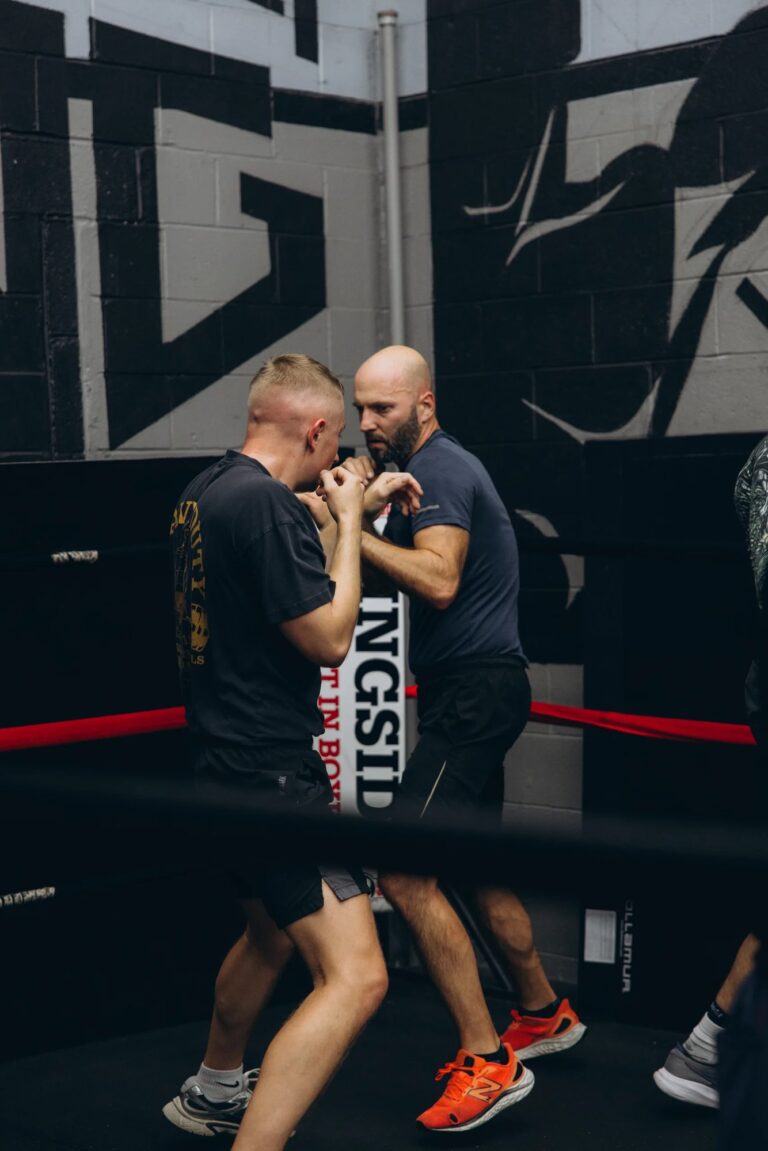
In a drill like this, one feeds the punch, the other answers it, and the corner again gives both of them a fixed reference for distance. In a drill like this the feeder’s job is as important as the defender’s — a punch thrown too fast or off-line teaches the wrong reaction, so the pace stays slow enough that the defender sees the hand leave and chooses the answer.
The honest answer to the question: boxing is a contact sport, and anyone who stays with it long enough will eventually feel a glove. But partner drills at the beginner stage are controlled and cooperative, and hard sparring belongs to competitive boxing — a stage of the craft, not a day-one event. Competitive boxing is something we offer and respect; it simply suits a person who has already built the defensive timing these drills are teaching. Boxing training for adults who want to test themselves in the ring leads there later, by choice, not by surprise.
What to bring — and what you do not need to buy yet
For a first beginner boxing class, bring comfortable sportswear, clean shoes to change into, water and a towel; gloves are available at the gym, so nobody needs to buy a pair before the first visit. That is the whole list of what to bring to boxing class.
Each item earns its place. Bring clean shoes to change into — footwork lives on grip, and a beginner learning to pivot on the ball of the foot needs the sole to hold, not slide. Bring water and a towel. Comfortable sportswear means anything you can move and sweat in without adjusting it mid-round.
What to leave at home for now: your own gloves — gloves are available at the gym. These are real pieces of equipment, but the decisions behind them — glove weight, wrap length, the fit of a mouthguard — are easier after you know you want to continue with boxing classes and the coach has seen your hands and your style. The nearest boxing gym does not need you to arrive equipped; it needs you to arrive.
| Bring | Not needed for the first class |
|---|---|
| Comfortable sportswear | Your own gloves — available at the gym |
| Clean shoes to change into | |
| Water | |
| Towel |
Which group to come to
A first-timer should match the group to the person, not to perceived skill. Our boxing academy runs groups for kids from age 6, teens, adults and women, and each suits a different person rather than a different level.
- Kids boxing — youth boxing classes for kids from age 6, where the first weeks are stance, footwork and pads.
- Teen boxing — for teens, starting from the same stance, footwork and first punches as every beginner.
- Adult boxing groups — an adult man who has never trained goes to the men’s group, where boxing lessons adults receive start from the same stance and jab as everyone else.
- Women’s boxing — for a woman who prefers to learn those same movements in a women’s group.
Call or text (732) 339-2894 and we will tell you which day and time your group trains.
Mistakes first-timers make — and how to avoid them
The most common first-class mistakes in beginner boxing are habits of the body, not failures of effort, and each has a simple fix.
- Holding your breath while punching. Tension builds, the shoulders rise and the punch slows. Fix: a short, sharp exhale on each punch — the sound is part of the technique.
- Squeezing the fist the entire time instead of only on contact. A clenched forearm tires in minutes. Fix: keep the hand relaxed in the guard and close it as the punch lands.
- Standing square instead of in stance. A square body has no reach and no defense. Fix: lead foot forward, rear foot back, weight between them — the first thing boxing lessons correct, and worth re-checking after every drill.
- Trying to punch hard before punching correctly. Power without shape is a shoulder injury waiting for a bag. Fix: slow, full-range punches in shadow boxing until the path is clean.
- Skipping the warm-up. Cold shoulders and ankles do not pivot well. Fix: do not skip the warm-up.
- Comparing yourself to people who have trained for a year. Their rhythm is the product of time, not talent. Fix: compare this week’s stance to last week’s.
- Buying expensive gear before the second class. Fix: use the gym’s gloves until you and the coach know what you need. This applies equally in fitness boxing classes, where conditioning is the first goal — the technique rules do not change.
After the first class: where beginners go from here
After a first beginner class, light soreness in the shoulders and calves the next day is normal and fades within a few days — the shoulders from holding the guard, the calves from staying on the balls of the feet. From there, the paths differ by what a person wants, not by rank.
| Path | Who it suits | What a week looks like |
|---|---|---|
| Group boxing classes | Steady skill and routine | Regular group sessions building stance, punches, footwork and defense |
| Fitness boxing and circuit training | Conditioning as the first goal | Boxing movements combined with circuit training rounds |
| Personal boxing training | One-on-one correction, or a schedule groups do not fit | Individual sessions focused on the person’s own errors and goals |
| Competitive boxing | Those who later want to test themselves in the ring | Progression from controlled drills toward sparring and preparation |
Fitness boxing classes and circuit training suit the person whose first question is “will I get in shape,” and boxing training for adults in a group suits the person whose first question is “will I learn to box”; both are boxing, with different emphasis.
How to come to your free first group class
Your first group class in beginner boxing is free: call or text (732) 339-2894, say who is coming — a child from age 6, a teen, an adult, a woman — and whether they have ever trained, and you will get the day and time of the right group. Bring comfortable sportswear, clean shoes to change into, water and a towel; gloves are available at the gym.
Our boxing academy is located in Huntingdon Valley and works with people from Philadelphia and Northeast Philadelphia, as well as Bryn Athyn, Southampton and Bensalem, who are looking for beginner boxing classes or simply boxing classes near me. One honest line before you call: we teach boxing only. There is no kickboxing and no Muay Thai at this boxing gym, so someone looking for those should look elsewhere. Someone looking for a first boxing class where the coach shows and explains everything should pick up the phone.
FAQ
- I have never exercised and I am out of shape. Can I start beginner boxing?
Yes. A beginner class teaches movements — stance, guard, the first punches, footwork — and conditioning builds over weeks as a byproduct of showing up. Nobody is expected to arrive fit, and the coach explains everything from the first minute. Bring water, a towel, comfortable sportswear and clean shoes to change into; gloves are available at the gym.
- Do I need my own gloves for the first class?
No — gloves are available at the gym. For your first beginner boxing class bring comfortable sportswear, clean shoes to change into, water and a towel. Your own gloves, hand wraps, a mouthguard and headgear are decisions for later, once you know you want to continue and the coach has seen your hands and the way you punch.
- What should I wear to a beginner boxing class?
Comfortable sportswear you can move and sweat in, plus a clean pair of athletic shoes to change into. Add a bottle of water and a towel.
- Why do beginners shadow box before hitting the bag?
Shadow boxing lets the body learn the shape of a punch and the stance without the distraction of impact, so errors in the hand path, the elbow and the guard are easier for the coach to see and correct. In a boxing gym it is often done in a corner of the ring, where the ropes give a fixed reference for distance and movement.
- Which group should an adult beginner join?
An adult man who has never trained joins the men’s group; women can choose the women’s group; kids from age 6 go to the younger kids’ or older kids’ group. Call or text (732) 339-2894 and we will tell you which day and time that group trains so you arrive when it is on the floor.