Adult Boxing Classes in Philadelphia: Start at 30+
November 21, 2026
Adult boxing classes answer one fear directly: that a man who has never boxed and is now in his thirties or forties has missed his window. He has not. Boxing is a set of mechanics — stance, guard, jab, step, slip — learned by repetition, and repetition does not check your age before it works. At KRASAVA Boxing Academy that learning happens in the men’s adult group, and the first group class is free, so the decision can wait until you have actually stood in the gym.
Key takeaways
- Adult boxing classes are built from mechanics learned by repetition, which is why beginner boxing with zero experience in your thirties or forties is a workable starting point.
- The men’s adult boxing group trains Monday, Wednesday and Friday at 7:30 PM.
- The coach shows and explains everything even if you have never boxed.
- The first group class is free.
- Call or text (732) 339-2894; the gym is in Huntingdon Valley and serves Philadelphia and Northeast Philadelphia.
Can you learn boxing as an adult who has never thrown a punch?
Yes — an adult who has never thrown a punch can learn boxing, because boxing is a skill built from a handful of mechanics, and each one is learned by repetition, not by having started at twelve. Stance, guard, the jab, the step, the slip: five pieces that every combination and every defensive move is assembled from. Beginner boxing is the deliberate building of those five pieces, and the method does not change with age — a beginner does the movement until it stops needing his attention.
A common pattern in the trade is that a man in his thirties or forties picks up boxing technique faster than a kid. The adult listens. The adult asks why the back heel turns on the right hand instead of just throwing it harder. The adult does not try to win the first week, so he is not fighting his own ego while learning. What usually gets in the way of adult learners is not age but impatience with looking clumsy, and that impatience fades once the stance stops feeling foreign.
The man who googles “starting boxing at 20” and already feels behind should hear this plainly: starting boxing at 20 and starting in your forties are the same path — same stance, same jab, same mirror. Nobody in adult boxing classes is being measured against an amateur career clock. Nobody is expected to know which foot goes forward, how to hold his hands or what a pivot is before the first evening.
What adult boxing classes look like at our gym serving Northeast Philadelphia
Adult boxing classes at KRASAVA Boxing Academy mean the men’s adult boxing group, and it trains Monday, Wednesday and Friday at 7:30 PM — an evening slot a working man can make after a shift or an office day without rearranging his week. A man who walks in without knowing how to wrap his hands or where to stand at the bag is not left to copy the guy next to him and guess: the coach walks every first-timer through it, whatever he arrives knowing.
- Monday — 7:30 PM — Men’s adult group
- Wednesday — 7:30 PM — Men’s adult group
- Friday — 7:30 PM — Men’s adult group
Shadowboxing is where the stance and the jab get corrected with nobody hitting back; the bag is where the corrected movement gets power behind it; partner drills are where defense is learned against a man who is helping. For a first-timer that order explains what the word “class” means in a boxing gym: a session organized around learning the movements, with correction built in, rather than around any single piece of equipment.
The gym itself is in Huntingdon Valley — that is the address on the door, not a different market — and the areas it serves are listed in the closing section below.
Reflex and hand-eye drills: the part adults think they have lost
Reflex and hand-eye drills exist because reaction in boxing is mostly pattern recognition, and pattern recognition is learned, not inherited. The fast boxer is not the man with a faster nervous system; the fast boxer is the man whose eyes pick up the start of a punch earlier, so his hands have more time. That reading of an opponent is built with small, repeatable tasks for the eyes long before it is tested in a boxing ring.
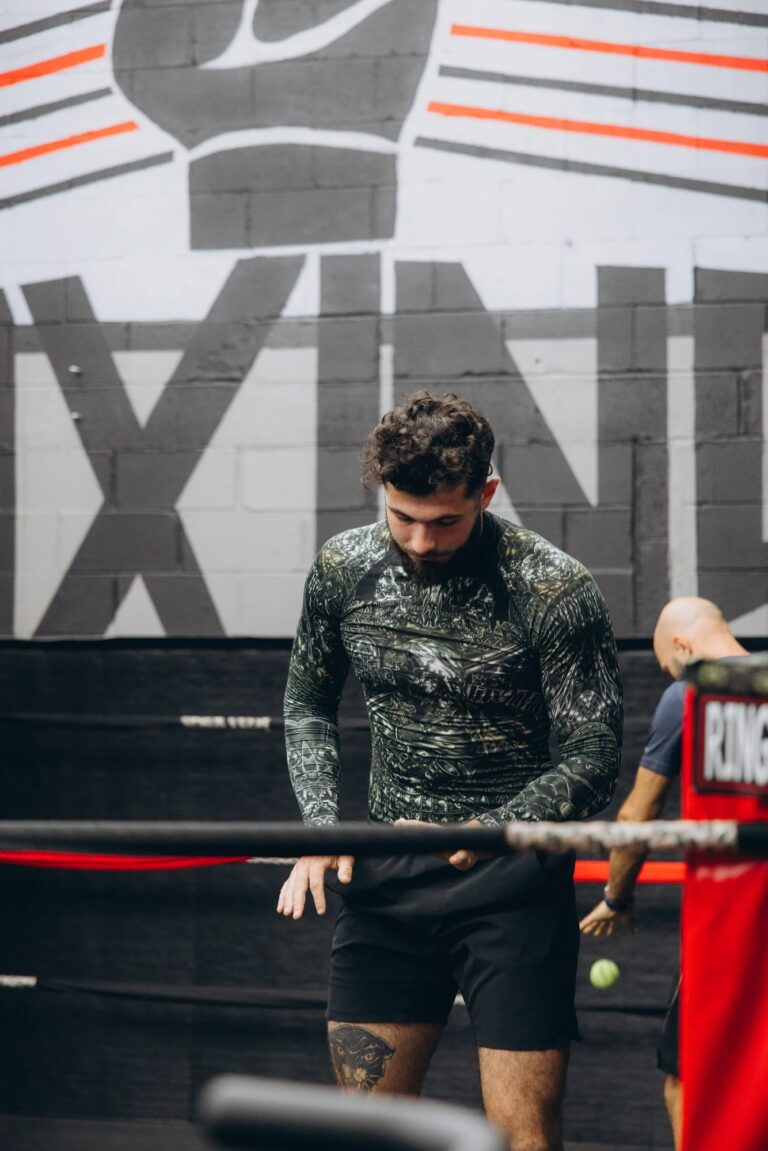
One of our boxers, an adult in a rashguard, is working a tennis-ball reflex drill at the ropes of our ring under the BOXING mural, in our gym. The point of using a ball is that it is small and light: the eyes have to find it early, the hands have to answer without a wind-up, and nothing lands on the man while he is learning to react. A beginner can miss the ball fifty times in a row and lose nothing but a ball on the floor.
Tracking a small moving object trains the eyes to read a glove the way they will later read an opponent’s shoulder — the shoulder moves first, the glove arrives second, and a boxer who watches the shoulder is already ahead. For the man in his late thirties convinced his reflexes are “gone”, the honest craft answer is that he never had boxing reflexes to lose. He had general reaction time, which is not the same skill. Beginner boxing builds tracking and reaction from scratch because the pattern being recognized did not exist in his head before he started.
Defense drills in the ring corner: learning not to get hit
Defense in boxing is built against a cooperative partner long before anyone exchanges real punches. In the standard version of the drill, one man feeds slow, agreed punches — a jab, then a jab and a right hand — and the other works the guard, the parry, the slip and the step that takes him out of range. Gyms often run this work in a corner of the ring, because a corner is where a boxer least wants to be caught, which makes it the place where getting out is worth rehearsing. A beginner spends a long time catching, blocking and moving against someone who is helping him, not hunting him.
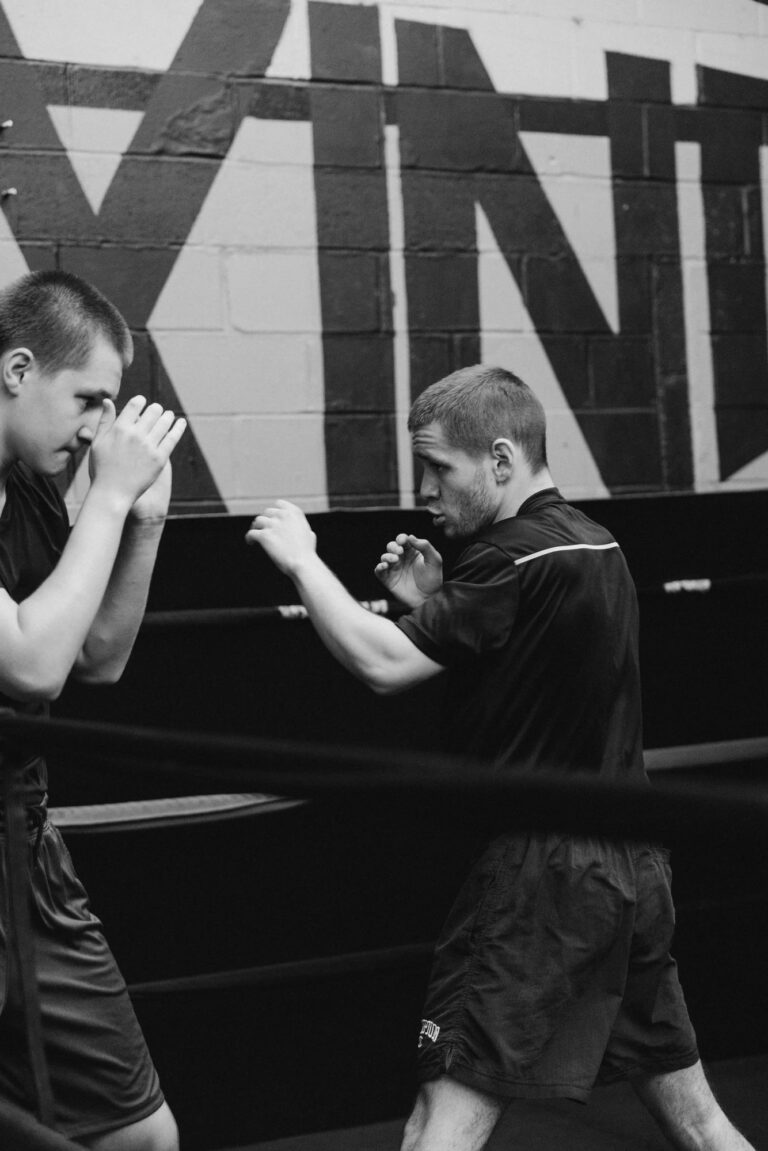
Two adult boxers practice a partner defense drill in the corner of our ring, a black-and-white shot taken in our gym. In this type of drill the feeder’s job is to give the defender something to read — a punch slow enough to see, honest enough to matter — and the roles usually switch so both men learn both sides of the exchange.
The honest adult worry is some version of “I don’t want a broken nose at 38.” Partner defense drills are the opposite of a brawl: they exist to teach a man not to be where the punch lands, and boxing lessons for adults build guard, parry, slip and footwork the same way the sport builds them at every other level.
Competitive boxing is one of the services at our boxing academy. Learning to defend yourself competently in a ring and choosing to fight in one are two different decisions.
Fitness boxing and circuit training vs. the technical group: which suits you
Fitness boxing and circuit training suit the man whose goal is conditioning; the adult boxing group suits the man whose goal is learning to box. Both are boxing classes at our gym, and neither is the lesser choice — they answer different questions. A man who wants to lose weight and hit something after work and a man who wants to actually learn the sport are both right; they just need different formats.
| Fitness boxing / circuit training | Adult boxing group | |
|---|---|---|
| Goal | Conditioning, weight, stress release | Learning to box |
| What a session emphasizes | Bag rounds, bodyweight stations, heart rate up | Stance, combinations, defense, partner work |
| Who it fits | The man who wants a hard, boxing-based workout on a schedule | The man who wants to understand the craft and build the mechanics |
Choose by goal, not by rank. Fitness boxing and circuit training are among our services — ask which fits your goal when you call. If it is “I want to learn the sport,” the adult boxing group is. The two goals are not in competition, and nobody is wrong for picking either one.
We also run women’s boxing, so a couple can train in the same boxing gym.
Group class or personal boxing training
The group meets Monday, Wednesday and Friday at 7:30 PM and gives partners for defense drills; personal boxing training gives one-on-one attention. Both are boxing lessons for adults at our gym, and the trade-off is attention against momentum.
In the group, a man learns from watching others miss the same things he misses, and the schedule does the discipline for him. Personal boxing training suits the man who is self-conscious about starting at forty in front of others and would rather get the basics down privately first, or who simply wants the coach’s attention undivided for a session — the hip turn on the right hand gets fixed on the spot, with no one else waiting for a turn. If an old shoulder or knee is part of the decision, that is a question for a doctor before it is a question for a coach.
Is learning boxing worth it after 40? An honest answer
Learning boxing after 40 is worth it for coordination, conditioning, stress release and the discipline of a fixed schedule — and the technical side of the sport has no age gate. Beginner boxing in your thirties, forties and beyond builds the same stance, jab and defense as it does at 20. The one thing starting boxing at 20 buys that starting at 40 does not is a shot at a professional career. That path belongs to the twenty-year-olds, and the adult boxing group makes no such promise to anyone.
It is not worth it, or not yet, for a man who should talk to his doctor before the first class. A coach is not a physician. Uncontrolled blood pressure, a recent concussion, heart conditions and eye conditions are the common reasons to get cleared first, and a boxing gym is the wrong place to find out about any of them.
Boxing with partner drills is also the wrong tool for the man who hates contact and only wants cardio. Forcing himself through work he dislikes is a poor use of his evenings; fitness boxing or circuit training may fit his goal better. Choosing that format is not a failure; it is reading yourself correctly before committing to the wrong class.
Your first free class: what to expect and what to bring
The first group class is free, and that is the whole point of it: you see the boxing gym, the ring, the group and the coach before deciding anything — and the adult boxing group gets to see what you can do, which for a first-timer is usually nothing yet, and that is expected.
The checklist for a first-timer in any boxing gym is short:
- Athletic clothes you can move in.
- Clean indoor shoes.
- A water bottle.
- A towel.
Hand wraps and gloves are the standard first purchases in boxing; until you own them, ask what to bring when you call or text.
The man who arrives knowing nothing is exactly who beginner boxing is for. Nothing you do not know yet is held against you — the coach shows and explains what a man who has never boxed needs, starting from zero. Walk in, listen, and see whether the boxing gym feels like a place you want to come back to.
How to start adult boxing classes in Philadelphia this week
Starting adult boxing classes this week comes down to one call or text and one evening: thirty or forty is not late, the first group class is free, and the men’s group meets Monday, Wednesday and Friday at 7:30 PM. The gym is in Huntingdon Valley and takes men from Philadelphia, Northeast Philadelphia, Bryn Athyn, Southampton and Bensalem.
Judge the boxing academy in person rather than on a page: there is nothing to prepare beyond the short checklist above and nothing to decide until you have stood in the gym. To book the free first group class at KRASAVA Boxing Academy, call or text (732) 339-2894.
FAQ: adult boxing classes
- Can you learn boxing as an adult?
Yes. Boxing is a set of mechanics learned by repetition — stance, guard, jab, step, slip — and none of them require having started as a kid. Adults often learn technique faster because they listen and ask why a movement works. In our men’s adult group nobody is expected to arrive knowing anything; the coach shows and explains it from the first evening.
- Is learning boxing worth it after 40?
For coordination, conditioning, stress release and a fixed training rhythm — yes, and technique has no age gate. It is not worth it if the goal is a professional career. Talk to a doctor first if you have uncontrolled blood pressure, heart or eye issues, or a recent concussion. If you hate contact, fitness boxing or circuit training fits better.
- When does the men’s adult group train?
Monday, Wednesday and Friday at 7:30 PM. The gym is in Huntingdon Valley and serves Philadelphia and Northeast Philadelphia. The first group class is free; call or text (732) 339-2894 to come in.
- What is the difference between a boxing fitness class and an adult boxing class?
Fitness boxing and circuit training suit the man whose goal is conditioning. Adult boxing suits the man whose goal is learning to box. Neither is better — choose by what you want out of your evenings. Both are offered at our gym.
- The group gives partners for defense drills and a fixed schedule that keeps you honest. Raise the choice when you call or text — the answer depends on what you want from your first weeks.
- Are reflexes too slow at 35 to box?
No. Reaction in boxing is mostly pattern recognition — reading a shoulder or a glove early — and it is trained, not inherited. Reflex drills like tracking a tennis ball by the boxing ring build exactly that skill, with a ball rather than a glove in front of you while you learn to see earlier. One of our photos shows this drill in our gym.