Boxing vs Kickboxing: Which Class Should You Pick?
November 21, 2026
Punches only, or kicks too — that is the whole question behind boxing vs kickboxing, and the answer shapes what your first months in a class will look like. Below it is laid out from the boxing side, with the other sport described fairly.
Key takeaways: the short version of boxing vs kickboxing
- Boxing classes are limited to punches — the closed fist, above the belt, to the front and sides of the head and body. Kickboxing adds kicks to the legs, body and head, and in some rule sets knees.
- Beginner boxing has a smaller toolbox: four punches, a high guard, footwork and head movement. Kickboxing has more to learn before anything feels natural.
- Both are contact sports. Neither earns a label like “gentler”; a class where the coach controls contact matters more than the sport itself.
- The right choice is the class you will keep attending twice a week.
- KRASAVA Boxing Academy teaches boxing only — no kickboxing, no Muay Thai — and the first group class is free.
Boxing vs kickboxing: the one rule that separates them
In boxing you may strike only with the closed fist, above the belt, to the front and sides of the head and body. No kicks, no knees, no elbows, no holding an opponent while hitting, and no hitting someone who is down. That is the whole list of legal offense under amateur and professional rules alike, and it is why boxing classes spend so many hours on so few movements. In kickboxing the list grows: kicks to the legs, body and head become weapons, and under some rules the knee joins them. Can you kick in boxing? No. A kick thrown inside a boxing ring is a foul, and repeated fouls can lead to disqualification.
Every other difference traces back to that single rule. When the legs are not a target, the stance can turn more sideways and sit lower; when the legs are a target, you stand more square and keep the lead leg ready to lift. Distance shrinks in boxing, because nothing reaches farther than an arm. Rhythm changes too: punches chain in threes and fours, while kicks need a reset between them. Anyone in Philadelphia or Northeast Philadelphia comparing a boxing gym with a kickboxing room is really choosing between the two columns below.
| Legal strikes in boxing | Legal strikes in kickboxing |
|---|---|
| Closed fist only | Closed fist |
| — | Shin and foot (kicks) |
| — | Knees, under some rule sets |
| Targets: head and body above the belt, front and sides | Targets: head, body and legs (low kicks allowed under many rules) |
What kickboxing actually is — and why it is not “boxing plus kicks”
Kickboxing is a family of rule sets rather than one sport. American kickboxing allows kicks above the waist, no knees, and is usually fought full-contact. International styles open up the low kick to the thigh. Muay Thai is a separate art with its own tradition: it adds knees, elbows and clinch work, where fighters hold and strike at the same time. Is kickboxing a martial art? Yes — a striking martial art and a combat sport in its own right. Is boxing MMA? No. MMA combines striking with wrestling and submissions; boxing is one of its striking components, and kickboxing is another. A boxing gym and an MMA gym train toward different contests.
The point of the heading is this: adding kicks does not bolt a tool onto a boxer. It rebuilds the base. The stance squares up so the lead leg can check a kick. The hands sit a little lower and wider to cover the ribs from shins. Distance stretches to kicking range, and footwork has to protect the front thigh instead of simply carrying the weight in and out. A kickboxer who takes up boxing has to narrow and relearn; a boxer who takes up kickboxing has to widen and relearn. That is why a boxing academy and a kickboxing gym feel different from the first week, not just from the first kick.
| Boxing | American kickboxing | Muay Thai | MMA | |
|---|---|---|---|---|
| Legal strikes | Fists only | Fists, kicks above the waist | Fists, kicks, knees, elbows | Strikes plus takedowns and submissions |
| Clinch allowed | No (broken by the referee) | No | Yes, with strikes | Yes, with strikes and grappling |
| Typical stance | Sideways, lower, weight under you | More square, upright | Square, upright, lead leg light | Square, ready to defend takedowns |
| What beginners learn first | Straight punch, high guard, footwork | Jab, cross, round kick | Teep, round kick, basic clinch posture | Stance, basic strikes, sprawl |
What boxing trains: hands, feet and the head that moves
Boxing trains a narrow set of punches — jab, cross, hook, uppercut — drilled to depth, together with a high guard, footwork and head movement. The guard covers the chin and the temples with the gloves and the forearms. The footwork keeps the weight under you so you can hit and step out without leaning. Head movement — slips, rolls, pulling straight back — is where the boxer vs kickboxer difference shows most clearly: kickboxers use it less, because a head that dips low meets a knee or a shin. Because the toolbox is small, boxing classes spend their hours on quality rather than variety. The same straight punch is thrown thousands of times until the elbow, the hip and the back foot arrive together. In a new boxer the shoulders tire first, from holding the guard up, then the calves from staying on the toes; the most common early mistakes are the rear hand dropping as the jab goes out and the chin leaning in behind the punch. Catching those two is most of what beginner boxing is built on.
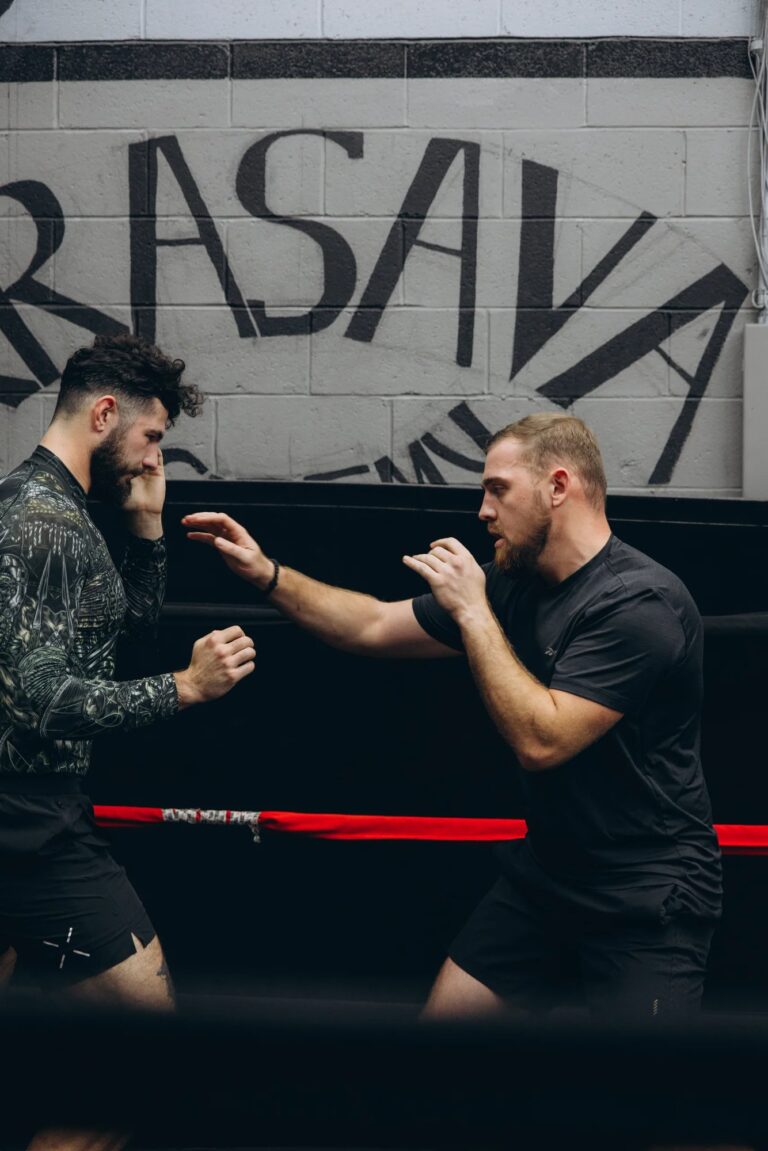
Two adults working a partner drill by the ring — one throwing a straight punch, the other holding a high guard, the KRASAVA mural behind them — is what partner work in a boxing class looks like. One throws a straight punch, the other holds a high guard. In partner work the drill is about distance and timing rather than power, and the high guard being tested is the first defense a new boxer learns, long before any head movement. Personal boxing training is by appointment.
What kickboxing trains that boxing does not
Kickboxing trains the hips, hamstrings and balance through round kicks, front kicks and checks — blocking a kick by raising your own shin to meet it. It conditions the shins to contact over time. It teaches you to stand on one leg under pressure, since every kick and every check puts you there, and to read distance at kicking range, which is longer than any punch. A boxing gym does not work any of those things directly; boxers build leg strength through footwork and rope, not through striking with the leg.
That is also why the first months of kickboxing feel clumsier than the first months of boxing. You are coordinating four limbs instead of two, defending low as well as high, and recovering your stance after each kick before the next move is available. None of that is a weakness of the sport — it is simply more to learn. For someone whose primary goal is leg strength and flexibility, kickboxing delivers that more directly than boxing does. We do not teach kickboxing or Muay Thai at KRASAVA Boxing Academy; the honest thing is to describe them accurately and let the reader decide.
Which is harder to learn as a beginner
Kickboxing is harder to start, and boxing is harder to get good at. Kickboxing stacks more techniques, more targets to defend and more balance demands onto a beginner at once, so the early weeks feel awkward. Boxing is easier to start because beginner boxing uses a short list — straight punches, a high guard, basic footwork — that most people can perform recognizably in their first weeks of boxing lessons. But with only two hands, every flaw is exposed: a late step, a dropped hand, a punch thrown off balance, feet crossing on the way out. The standard of hand skill expected in boxing is high precisely because the hands are all there is.
For a complete beginner, whether a child or an adult who has never trained, the smaller toolbox is a practical advantage. Competence on the fundamentals comes sooner, and feeling competent is what keeps people walking back into the gym. Starting boxing at 20 or later is common for exactly that reason: the fundamentals are few enough to learn as an adult with a job and a schedule. Conditioning difficulty is similar in both sports. A hard round of either leaves you breathing through your mouth, and neither has a monopoly on being tiring.
Which is more dangerous — the question every parent asks
Both boxing and kickboxing are contact sports, and in competition both carry real risk. Kicks add the legs as both weapon and target — shin, knee and thigh bruising are part of the sport — while boxing concentrates contact on the head and body at punching range. A parent asking which is more dangerous deserves that plain answer first, not a sales pitch. The distinction that actually matters for a child’s first year is a different one: a beginner class is not a fight.
In kids boxing, time goes to footwork, shadow boxing, bag work, pad work and controlled partner drills with gloves on, while the coach watches technique and decides how much contact a drill involves. Headgear and mouthguards are standard equipment in youth boxing, and hand wraps go on under the gloves. Sparring — two kids actually trading punches — is a separate decision made later, not something a beginner walks into. Competitive boxing is its own path that a family chooses or does not. Teen boxing follows the same order: fundamentals first, contact as a separate, later step.
So the honest comparison for a parent is not boxing vs kickboxing. It is a class where the coach watches technique and controls contact versus a class where nobody does. Ask that question of any gym you visit, in either sport. Standard youth boxing equipment for a beginner class:
- Boxing gloves sized for the child
- Headgear
- Mouthguard
- Hand wraps worn under the gloves
Boxing vs kickboxing for fitness — when the goal is getting in shape
Both sports burn a lot, and both start a new person in the same place: shadow boxing, jump rope, rounds on the bag, footwork drills and circuits. Fitness boxing and circuit training, as formats, are built on exactly those pieces: shadow boxing, bag rounds and circuits strung together in timed rounds. A women’s boxing gym is a common first stop for people returning to exercise after years away, for the same reason. The honest comparison: kickboxing adds leg and hip work and more balance, while boxing works the shoulders and core through punching, the legs through footwork, and the heart through rounds. Boxing is easier to pick up when you have not exercised in years, because there is less to coordinate before you are moving and sweating.
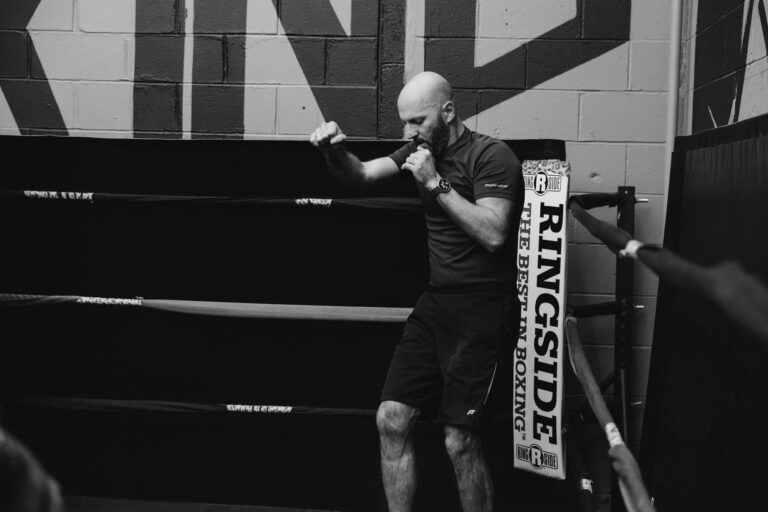
An adult shadow boxing alone in the corner of the ring, caught in black and white, is the piece of boxing that costs nothing and needs no partner, and it is where conditioning and technique meet in any boxing class — adult boxing groups and fitness boxing alike. Shadow boxing means throwing punches at the air while moving your feet, usually in timed rounds: the shoulders burn from holding the guard up, the calves from staying on the toes, and the lungs from keeping the pace. It is also the moment to fix a punch without a bag or a pad reporting the error. A newcomer who can shadow box a few rounds has a base for everything else in the class, and that base can be built at home between visits to the gym.
Self-defense, street fights and “who would win”
Boxer vs kickboxer, who wins, depends entirely on the rules of the meeting. Under boxing rules, the boxer. Under kickboxing rules, the kickboxer. In a ring with no rules, the better athlete with more experience — not the sport on their shirt. The question is popular because it is simple, and it is simple because it ignores everything that decides fights.
For self-defense, the unglamorous truth is that neither sport is a self-defense course. The most useful things either one gives you are the same: staying calm when someone is in your face, keeping your hands up, moving your feet instead of freezing, and breathing under pressure. Boxing classes build those in a shorter time because the skills are fewer; kickboxing adds range with the legs. Adult boxing groups include many people who never intend to hit anyone outside the gym, and that is a perfectly good reason to train. Neither sport should be chosen because of a hypothetical fight most people will never be in.
How to decide: kids, women returning to exercise, and men who think it is too late
Choose by what you will enjoy attending, not by which sport “wins” an argument. Each of the three people who usually ask this question has a different test to apply.
For a parent: ask whether your child wants to kick or wants to box. Then ask how the class handles contact and whether the coach watches technique during partner work. Kids boxing starts with kids from age 6, and a teen who wants to compete has a clear amateur boxing path in front of them: teen boxing leads into the competitive boxing track for those who want it, and stays a sport for everyone else.
For a woman worried about fitness: pick the sport whose class you will actually attend twice a week. Both get you in shape. Boxing has less to coordinate at the start, which is why a women’s boxing gym is often where people coming back to exercise begin — shadow boxing and bag rounds ask nothing of you on day one except showing up.
For a man who thinks 20, 30 or 45 is too late: it is too late to turn pro, and that is the only thing it is too late for. Adult boxing groups include many people who started as adults; starting boxing at 20 or later is a normal path into boxing lessons, not a late one. Personal boxing training is one-on-one, by appointment, for those who prefer to begin that way.
- Want to use your legs as weapons and build kicking range? Kickboxing.
- Want to go deep on hands, footwork and head movement? Boxing.
- Not sure? Try a class in either sport and see which one you want to come back to.
What KRASAVA Boxing Academy teaches — boxing only
KRASAVA Boxing Academy teaches boxing — no kickboxing, no Muay Thai. If you have read this far and decided you want to kick, this is not your gym, and that is said without apology. For readers choosing boxing, the boxing gym runs group boxing classes for kids, teens and adults — youth boxing for kids from age 6 and teen boxing alongside the adult groups — plus women’s boxing, fitness boxing and circuit training, personal boxing training by appointment, and a competitive boxing track for those who want to test themselves. It is a boxing academy in the plain sense: one sport, boxing.
For anyone in Philadelphia or Northeast Philadelphia looking for a boxing gym close by: the gym’s address is in Huntingdon Valley, and we serve Philadelphia, Northeast Philadelphia, Bensalem, Southampton and Bryn Athyn. The price depends on the type and number of classes.
Try a boxing class first — the first group class is free
The way to settle boxing vs kickboxing for yourself is to stand in a class, put the gloves on and throw a straight punch at a pad. Reading comparisons answers the question in the abstract; a beginner boxing class answers it in your own body — for the parent weighing youth boxing for a child, the woman who has not exercised in years, and the man who thinks he is too old. Don’t be afraid to come the first time: the coach will show and explain everything, even if you have never boxed before. The first group class at KRASAVA Boxing Academy is free — call or text (732) 339-2894 to pick a day for yourself or your child.
FAQ: boxing vs kickboxing
- Is it better to do boxing or kickboxing?
Neither is better in the abstract. Boxing is punches only and quicker to pick up; kickboxing adds kicks and direct leg and hip work. Choose by what you will enjoy attending twice a week, and by the quality of the class rather than the name of the sport. At KRASAVA Boxing Academy we teach boxing only, and the first group class is free.
- What is more difficult, kickboxing or boxing?
Kickboxing is harder to start: more techniques, more targets to defend and more balance demands land on a beginner at once. Boxing is easier to start and harder to get good at, because with only two hands every flaw in footwork, timing and defense shows immediately. Conditioning demands are similar in both — a hard round of either leaves you breathing heavily.
- Is kickboxing just boxing but you can kick?
No. Adding kicks changes the whole base: the stance squares up to check kicks, the guard sits lower to cover the ribs and lead leg, distance stretches to kicking range, and the rhythm resets between kicks. Kickboxers also use less head movement, since ducking low meets a knee or a shin. The two sports share punches but not their foundation.
- Can you kick in boxing?
No. Boxing allows closed-fist strikes only, above the belt, to the front and sides of the head and body. Kicks, knees, elbows, holding while hitting and striking a downed opponent are all fouls, and repeated fouls can lead to disqualification. That single rule is what separates boxing from kickboxing, and everything else — stance, distance, rhythm — follows from it.
- Boxing vs kickboxing — which is more dangerous for a child?
Both are contact sports, and competition carries risk in either. For a child’s first year the deciding factor is the class, not the sport: youth boxing beginners work footwork, bags, pads and controlled partner drills in gloves, with headgear and mouthguards as standard equipment. Sparring is a separate, later decision, and competitive boxing is a path a family chooses or does not.
- Does KRASAVA Boxing Academy teach kickboxing or Muay Thai?
No. We teach boxing only — group classes for kids from age 6, teens and adults, women’s boxing, fitness boxing and circuit training, personal boxing training and a competitive track. The gym’s address is in Huntingdon Valley, and we serve Philadelphia and Northeast Philadelphia. The first group class is free: call or text (732) 339-2894 to pick a day.